
An introduction to Kyle Kent's Substack
My purpose for starting this substack is to talk about my experience starting, growing & managing a beverage alcohol company... and create some inbound deal flow for my insurance business.

This is my first substack post. My purpose for writing this is to vent. Vent about all the people who did me dirty and for those who have helped me continue to stay in business. Without further ado -
I graduated college in 2020 and that August I took a job working at Staples in the Finance Rotational Development Program (back office). I was making $65K per year in base salary and because the company was owned by a PE firm, there were no bonuses. (Thanks Sycamore).
6 months into the program I realized that I was in the wrong place. The job was monotonous, mostly data loads, tie-outs and spreadsheet tasks that were the same day to day. My manager and (director-level personnel) were only making twice as much as me had been in the industry for 10-20+ years. I had IB & management consulting friends making more $$ their first year out of college. Talk about a low ceiling...
January 2021 everything changed. COVID reared its head and was making its way to the states. I remember my two roommates and I all worked from home in our 1,200 sq foot Boston apartment.
At the same time I started reaching out to beverage labs to begin formulating an alcoholic gatorade. By March my roommate and I signed off on a $16,000 R&D proposal to develop 4 flavors. (Then an $18K proposal to design our packaging). We had chosen that specific beverage lab (Ocean Blue Innovation) because I liked the fact we could communicate directly with the CEO (Marty Molina) who had former experience working at Pepsi. In March we flew out to LA for an on-site lab day and by EOD we had 4 formulas and some initial package design. We thought we were going to be RICH overnight.
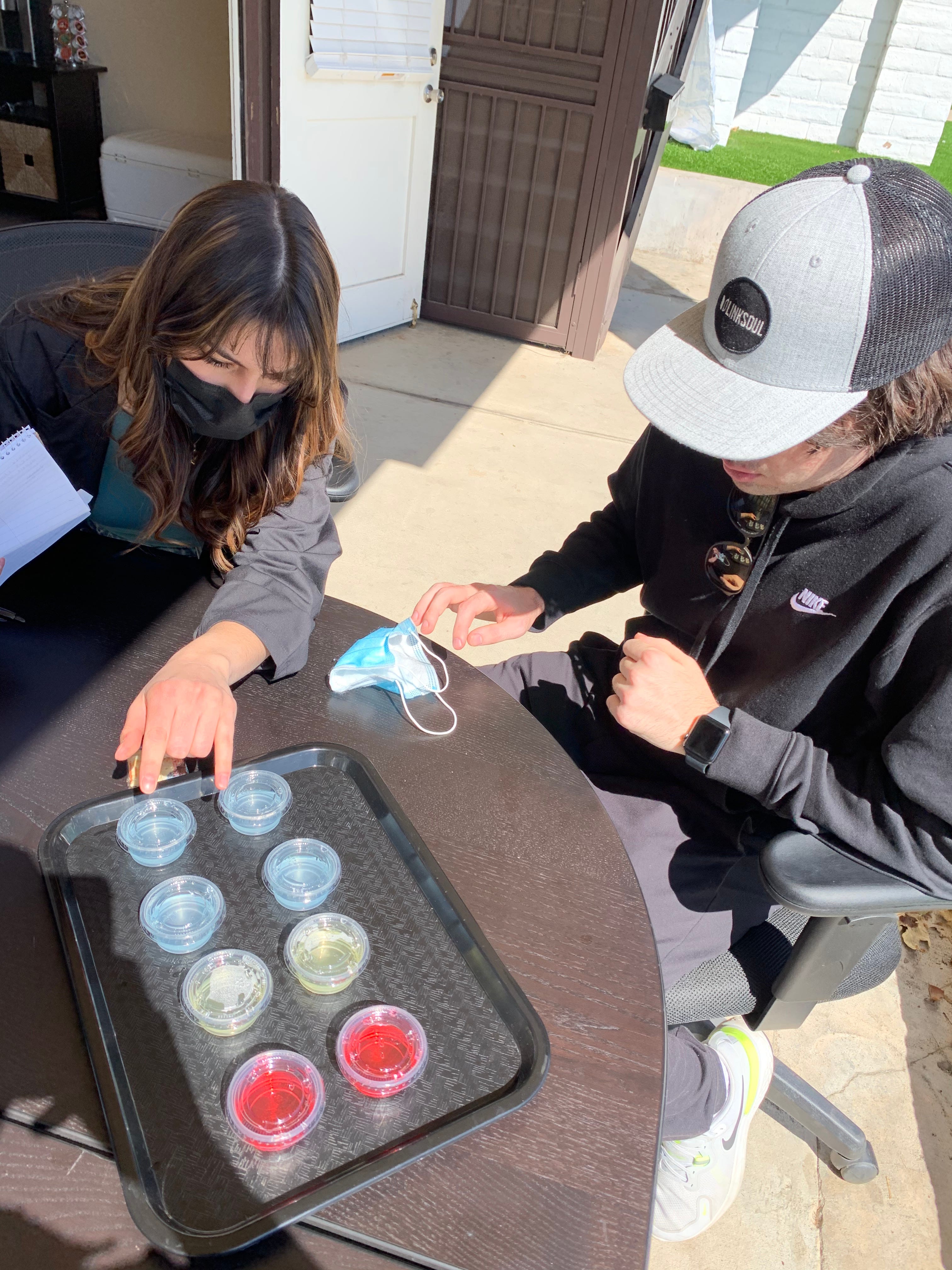
Samples in hand we began reaching out to distributors. I targeted Martignetti because the third-generation owner was an alum of Tabor Academy, where my partner and I met. I had met him briefly at my graduation and wanted to keep the business "in the family." My partner reached out to his neighbor who owned Horizon Beverage. It's not easy getting into a distributor with no previous sales or experience. These guys sell Tito's, Grey Goose, Casamigos & Bacardi - they don't need nor care much about your tiny local "brand"... and we didn't have a brand, we had a collection of products (SKUs). They really decide who gets access to the market and who doesn't. Luckily because of our "connections" we were able to land Horizon, which sparked the first of many debates between my cofounder and I.
With a few samples of each flavor and a distributor committed to ordering 600 cases (24 cans = 1 case) we began reaching out to VC firms to raise money for an initial inventory run. Everyone turned us away because we were too early (and also because the VC model is predicated on home runs... more than likely that an RTD vodka business does not fit into their investment thesis whereas a software business may). But one day, a mutual friend of ours had connected us with his uncle who made an intro to a billionaire and after 2 meetings we had a $100K check. The meeting had nothing to do with our financials or past experience. He wanted to know more about my relationship with my cofounder and I think he wrote us a check partly as charity. Since we had a lead investor to lend us credibility, we felt better about taking money from family and close-friends, all in all we raised $364K. That closes the books on June 2021. We asked our $400/hour corporate lawyer to draft up the agreements and $10K later it was official. We raised at a $1.5M post-money valuation. (2 years later, our lawyer's hourly rate increased to $550, LOL). All of the vendors I worked with tried to make money off me, few offered real insights. My lawyer, Matt Whitehead at Feinberg Hanson was someone who knew what the fuck he was talking about and offered really creative ideas for financing and writing people into the business.
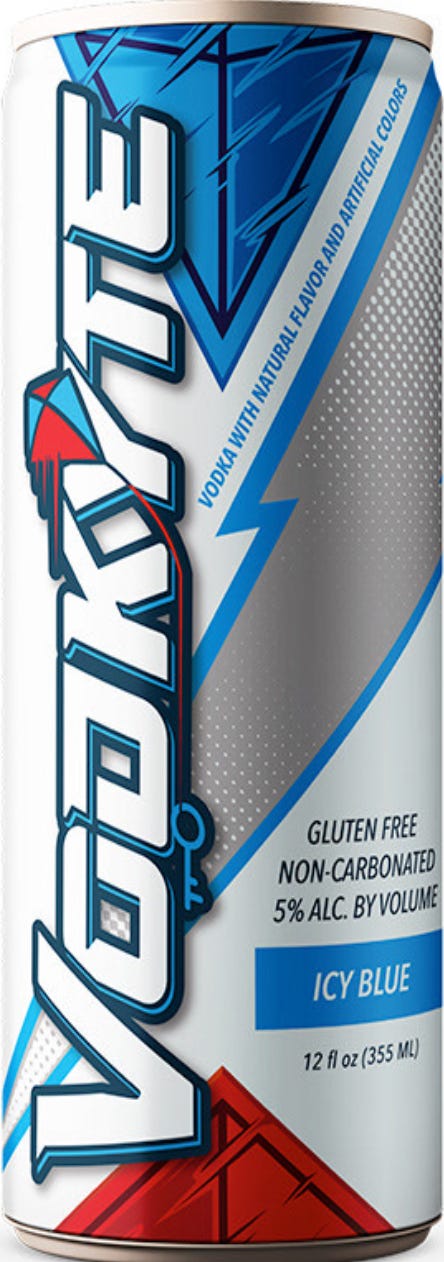
Let the good times roll.....
The beverage lab had made an introduction to Ninth Planet, a beverage co-manufacturer in upstate NY (whom I currently do business with). The owner insisted we start with a pilot batch of ~10,000 cans per flavor to make sure we had the kinks worked out on our new formulas. He warned us about the beverage lab we had chosen, citing problems with clients formulas who had been referred by that lab. Because we were 23 (and thought we knew better) we decided to go with a much larger co-man in Cincinnati, OH - Impact Brews - and decided to run 5,000 cases of variety 4-packs and 12-packs (1 case = 24 x 12oz cans) for a total of ~120,000 cans. We were one of their first outside clients and I coordinated the whole thing from my laptop without ever visiting the facility. It was a lot of micro-managing on my end. In November 2021 our inventory run began.
****My uncle passed away a week prior to our inventory run and rather than be in Ohio at the copacker I was in DC with my family sorting out his estate for the first 3 days of our production run.
The CEO of the co-man, Whit Hesser, noticed the plastic sleeves on our cans were dangerously high. We had bought our cans from Grady Ludeke, owner of Eastgate packaging, on his request. Unlike big players who order 1M printed cans directly from Ball or Crown, smaller outfits are forced to buy shrink sleeved cans. The difference with sleeved cans is the MOQs are lower, they cost 3x as much as printed cans, and there is a risk if the sleeve is too high to interfere with the seam of the lid. He asked me if I wanted to press on or wait until we could order new cans. As I was in DC, and my partner on the ground wasn't as in-the-know on the supply chain end of things, I told him to press on. That was probably the biggest single mistake I made running the business.
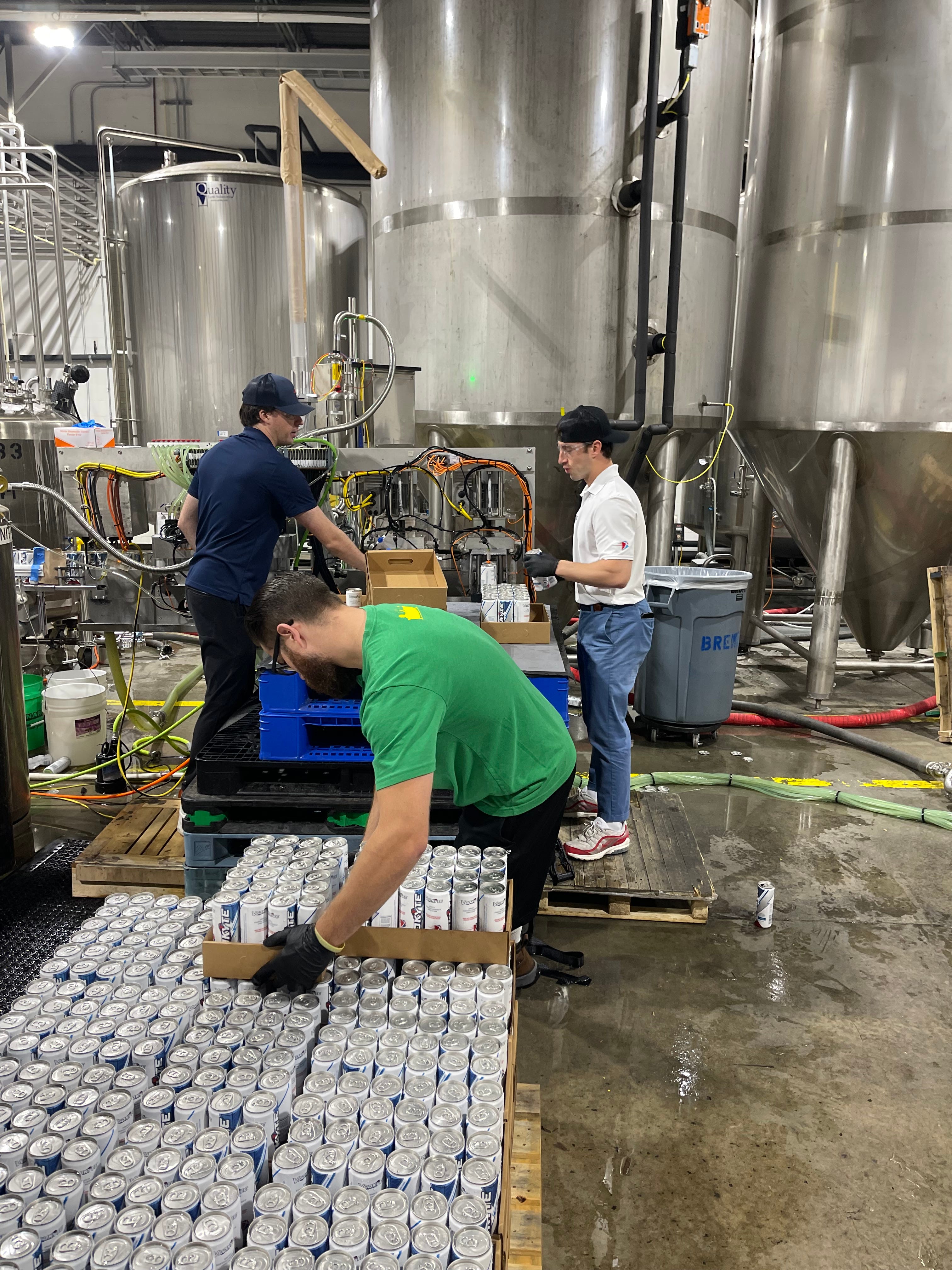
We pressed on and 3 days later I arrived in Ohio to catch the last 2 days of our production run. On the last day, the mobile canners didn't show and we were forced to stack the cans into trays and palletize them ourselves. That was a 16 hour day that involved lots of drinking. Probably the longest working day of my life. But because of the electrolytes, I didn't get a hangover 😉
For those who don't know how the alcohol business works in the US we operate under the three-tiered system. Namely, the supplier, distributor, and retailer operate in that order. The supplier (me) makes the product, the distributor buys it from me, then re-sells it to the retailer, who sells it to you. Regardless of what my margin is, the distributor and retailer each make about 30% on gross margin. So say I sell a case to my distributor for $40/case or $1.67/can. The retailer buys it from the distributor for between $60-55/case or ($2.40/can). Then sells it to you for $80/case or $3.50/can. Everyone wins! Except for the customer who pays the higher price. This model works well for the big guys but not necessarily for the small guys. Any distributor will tell Little co. that it's your job to sell the product into retailers, not theirs, they carry 19,000 SKUs and you're just 1 of them.
We did something like $88K in wholesale revenue to our distributor in the first 6 weeks. That's a bit misleading though. We sold $88k worth of product to our distributor, but it was going to take them much longer than that to move through that inventory. In February 2022 we noticed there were some serious issues with our product. The liquid did not taste as it should've. It tasted sour, as if there was bacteria growing in the liquid....
I'll save that part of the story for another post. Thanks for reading.
Kyle